OurDream vs Joi: Adult AI Companion Decision Worksheet 2026
Use a fixed sequence and record what remains unknown. The objective is a defensible personal choice, not a dramatic score or an unverified product claim.
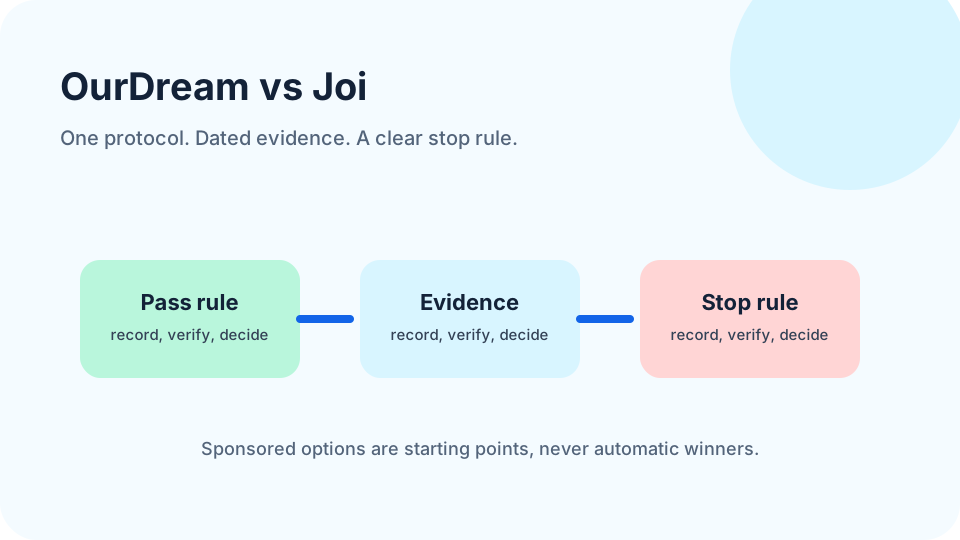
Write a pass condition before opening either service
An OurDream vs Joi comparison should start with a pass condition you can observe. Examples include maintaining a corrected fictional detail for the rest of a short session, respecting an explicit adult-roleplay boundary, exposing the media control you need, or presenting a commitment and exit you can understand. Avoid a pass condition such as feels best. It is too easy for novelty, design or a single polished reply to decide the outcome.
Add one unacceptable outcome and one unresolved outcome. An unacceptable result stops the test immediately. An unresolved result means you need stronger evidence before paying. This distinction matters because missing information is not automatically a negative product fact, but it is still a valid reason to pause your purchase. Date the card and identify the device or browser context so later observations do not overwrite it.
Use a fixed five-turn conversation sequence
Create one harmless fictional-adult setup. In turn one, establish the scene and tone. In turn two, ask the companion to make a choice. In turn three, correct a detail. In turn four, move to a related topic. In turn five, state or repeat a boundary. Paste the same wording into OurDream and Joi. Keep the turn limit fixed even if one reply invites a longer exchange.
Record relevance, initiative, correction use, continuity and boundary handling with short factual notes. Do not infer long-term memory from the current thread, and do not call a boundary safe based on one response. The protocol is a buyer filter, not a scientific benchmark. Its value comes from treating both options equally and revealing whether one workflow requires materially more steering for your purpose.
Score with words, not decimal ratings
Use pass, mixed, unresolved or unacceptable for each requirement. Decimal ratings imply precision that a short comparison cannot support. Add one sentence explaining the label. For example, mixed can mean the reply followed the correction but lost the requested tone. Unresolved can mean the control exists in help material but was not visible in your account. These explanations are more useful than a number when you review the card later.
Do not average safety, price and conversation into a single score. A strong conversation result cannot cancel an unacceptable boundary response or an exit you cannot locate. Keep hard requirements separate from preferences. If both options pass the hard requirement, compare the trade-offs directly and choose the smaller acceptable commitment rather than inventing a winner from a blended total.
Inspect current media and account controls
If images, voice or video are part of your decision, test only with fictional material and the same modest brief. Note which controls are visible, how revisions work, whether generated media appears in a gallery, and what deletion route is available. Do not upload a real person's face or voice without permission. Keep the evaluation private and avoid creating non-consensual intimate material.
Then inspect memory, history and privacy controls separately. A media gallery, chat history and remembered preference may have different settings. Read dated official support or policy material and verify the account screen where possible. If storage or deletion remains unclear, write the question down. Do not fill the gap with an assumption from another platform or an old review.
Build the full first-commitment worksheet
At checkout, capture the amount due now, interval, renewal amount if visible, optional credits or units, and how to stop renewal. Record taxes or regional differences only as they appear in your checkout. Do not publish those account-specific numbers as universal pricing. The comparison needs the commitment you face, not a static table that can become stale.
Set a maximum first commitment and a maximum optional-spend amount before entering payment details. If the required test cannot be completed inside those limits, pause. A discount should not expand the test scope. Review whether the free or introductory access can answer the hard requirement and whether the paid step adds a necessary capability or simply extends usage.
Rehearse cancellation and deletion
Find the renewal control, account closure path and data deletion request for OurDream and Joi. These may be distinct. Save the official route and the date you checked it. If support is required, note the expected dependency without claiming a response time you have not measured. The rehearsal should be read-only; do not close an account simply to complete this worksheet.
Decide in advance what triggers exit: repeated boundary failure, an unexpected commitment, a missing hard requirement, unclear data handling, or usage that no longer fits your budget. Set a calendar review before renewal. A good buyer worksheet includes the conditions for leaving, because switching costs can distort later decisions even when a service no longer fits.
Keep commercial evidence in its lane
The three buttons on this page are sponsored and carry route-specific tracking. OurDream and Joi are the named comparison; Lovescape is an unranked fallback if neither passes. Button order is not a score. A network payout can show that an offer produced paid activity somewhere in the measured system, but without a deterministic page and transaction join it cannot prove this page, query or product experience caused the event.
Likewise, a Plausible visit shows demand or behavior, not revenue. Search impressions show exposure, not satisfaction. Use each evidence source for the question it can answer. We may earn a commission if you choose through a sponsored link, at no extra cost to you. The worksheet must still support a no-purchase result when the evidence does not meet your pass condition.
Apply the worksheet to current options
Open only the options that match your written requirement. Verify present features, policies, regional access and checkout terms directly.
OurDream
Inspect the current destination, then apply the exact worksheet and stop rules on this page.
Inspect OurDreamCommercial disclosure: We may earn a commission if you choose through this sponsored link, at no extra cost to you. Placement is not a ranking.
Joi
Inspect the current destination, then apply the exact worksheet and stop rules on this page.
Inspect JoiCommercial disclosure: We may earn a commission if you choose through this sponsored link, at no extra cost to you. Placement is not a ranking.
Lovescape
Inspect the current destination, then apply the exact worksheet and stop rules on this page.
Inspect LovescapeCommercial disclosure: We may earn a commission if you choose through this sponsored link, at no extra cost to you. Placement is not a ranking.
Questions before you switch
Which is better, OurDream or Joi?
There is no verified universal answer here. Use a prewritten pass condition, identical fictional-adult prompts, current checkout evidence and a clear exit rule.
Does a sponsored link affect the comparison?
It should not. Sponsored destinations are disclosed and unranked, and the same requirements and stop rules apply to every option.
Can pageviews or affiliate payouts prove product quality?
No. Pageviews are behavior evidence, and payouts are commercial evidence. Without a deterministic join they do not authenticate a page, query or quality claim.
When should I choose neither?
Choose neither when a hard requirement fails, a boundary result is unacceptable, the commitment is unclear, or an important privacy or exit question remains unresolved.